

How Much To Install Kitchen Exhaust Fan
The Build
| Case Dimension (WxHxD) | 240 mm 10 510 mm x 505 mm / 9.45 in x 20.1 in ten 20.0 in |
| Form Factor | Mid Tower |
| Materials | Steel Chassis |
| Motherboard Support | East-ATX*, ATX, micro-ATX, mini-ITX (East-ATX upward to 280mm wide) |
| Front IO | USB-C GEN 2 2x USB 3.0 Microphone/Headphone Reset Push button Power Button LED Mode Button LED Color Button |
| Connectors | Ability Switch Reset Switch HD-audio D-RGB Power-LED HDD-LED USB 3.0 USB 3.1 GEN 2 D-RGB Expansion D-RGB MB Adapter |
| Side Window | Tempered Glass Window |
| PCI Slots | 7+iii vertical |
| Vertical GPU | Yeah iii-slots, with optional Riser Cable |
| Internal 3.5"bay | 10 (2x included, also supports 2.5" drives) |
| Internal 2.5"bay | iii (3x included) |
| Total Fan Mounts | 7 ten 120 mm / 6 x 140 mm |
| Front Fan | 3 x 120 mm / 3 x140 mm (three 10 140 mm D-RGB included) |
| Top Fan | 3 x 120 mm / 2 x 140 mm |
| Rear Fan | i x 120 mm / 1x 140 mm |
| Dust Filters | Front end / Top / Bottom PSU |
| Front end Radiator | Up to 360 / 420* mm |
| Top Radiator | Upwards to 360 / 280 mm |
| Rear Radiator | 120/140 mm |
| GPU Length | 435 mm / 17.2 in |
| CPU Libation Top | 190 mm / 7.five in |
| Motherboard Width | 280 mm / 11.0 in |
| PSU Length | 195/250 mm (iv HDD lesser brackets used/ ii HDD brackets used) |
| Cablevision Management | Velcro Strips / Slidable Cable Covers / Goose egg Tie Mounts |
| Parcel Dimension | 325 10 610 x 610 mm / 12.8 x 24 x 24 in |
| Cyberspace Weight | 8 kg / 17.6 lbs |
| Gross Weight | 10 kg / 22.0 lbs |
*Spec sheet taken from reviewer's guide, we don't necessarily concord with all claims
An unusual amount of attempt has gone into the cable management system behind the motherboard tray. Towards the front of the case, the broad cable management channel is covered with extremely long velcro straps that are screwed into the case. This aqueduct has 3cm of clearance for cables, while other areas behind the motherboard tray have simply over 2cm. The screws separate each strap into two halves, each of which loops effectually a hook built into the chassis. Critically, these hooks are open up, and so the straps can exist slipped on and off without having to painstakingly thread them through tiny holes, one of the most frustrating aspects of normal cablevision necktie points. The straps are placed both at the front of the case and the top edge of the PSU chamber, which covers almost every location that power cables must exist routed. Credit is due for a really exceptional job here. The ability supply shroud is also extremely roomy since the HDD cages aren't installed out-of-the-box, but fifty-fifty when they are installed they tin can be positioned forwards to leave plenty of cable room.

A recurring theme with Phanteks' cases, peculiarly the more expensive ones, is that they're feature-rich to a fault. Much like their Evolv 10, the P500A has a slot in the rear for an ITX bracket, purchased separately, that allows dual system support when combined with a compatible PSU, purchased separately. Reinforcing this feature is a vertical GPU mountain with a riser cable, purchased separately, that can be used to hold a discrete GPU for the secondary organisation while the primary organization uses the normal horizontal brackets. We tin can't be too harsh hither since these are optional add-ons, but hardly anyone will actually install a secondary organization in this case, then nosotros'd caution against reading too far into this bullet point unless yous're actually a legitimate user of such a configuration. A lot of people like the thought of the feature, just volition never use it -- but the case is plenty good on its ain. As for dual organisation testing, we generally advise against it in these more cramped enclosures, and you tin can read our Evolv 10 review for more thoughts and dual-organization testing.
We tin can be harsh about some other returning feature from the Evolv 10, though: the sliding cablevision covers at the front end of the case and on the top of the PSU shroud. We brushed them off with the line "these aren't especially useful" in the Evolv X review, and they notwithstanding aren't. They're overcomplicated, probably expensive, and as covers their function is literally to arrive the way. In add-on, the way the stock fan and LED cables are routed means that they can exist guillotined by the cable covers if they're slightly out of place. If Phanteks is ever looking for a way to cut costs, this is the place to get-go.

The HDD brackets that Phanteks includes with the case are a better investment. The brackets latch onto each other without screws and can exist stacked two high at three dissimilar locations nether the PSU shroud; equally many as 4 could be installed simultaneously, although only two are included with the instance. There are also mounting locations for vi more brackets behind the cable covers.
The glass panel uses one of the best zipper mechanisms: a swivel with magnets to hold information technology closed. The door lifts right off of the hinges, the hingepins are of unequal length so that the panel is easy to line up and reinstall, and in that location are rubber strips effectually the edge of the glass for cushioning and sealing. Phanteks has washed nearly everything right hither, with some small-scale exceptions. Start, there's not really any handle to pull on, although at that place is a thin cutout on the front end panel that allows some grip. Second, the panel isn't supported at the bottom edge and tin "droop" slightly, leaving gaps. Finally, nosotros'd similar to run across a way to spiral the glass panel down deeply while moving the case, rather than just relying on the magnets. Taking the glass panel off before picking upward the P500A is prudent, simply to avert any swinging door mistakes.

The other side is a great example of how to make a panel out of a sail of steel without having it exist a complete pain in the ass. The sheet metallic is thick, the tabs that hook into the instance are short and therefore sturdy, the holes they insert into are big and difficult to miss, and there are just tabs on two sides of the panel: three at the front and 2 on top. This may not sound exciting, simply it's innovation in an area that matters: this is a existent improvement over the P400A. The front panel has a U-shaped design stamped into it, which may be reinforcement to forbid flexing of the extra-wide mesh panel. The panel attaches to the chassis with brawl-and-loving cup snaps like other cases in the series, just using plastic posts molded into the frame of the panel. Previously these were metal posts tacked onto the edge of the metallic mesh. The new method is probably cheaper, but seems just as sturdy in our short-term testing. As with the P400A and P300A, Phanteks uses a fine metallic mesh with no additional filter backside information technology, which allows for better airflow.
As they've done in the past with some other premium cases, Phanteks ships the screws for the P500A sorted into an organizing tray. Information technology's just a plastic box, simply without hyperbole, this is 1 of our best favorite instance accessories. We have drawers and drawers full of extra screws, but most users purchase cases infrequently and will need to go on track of the original hardware for years. NZXT did this mode back in the day with the Phantom 820 and like cases, but in what's probably a painful note for NZXT, Phanteks seems to have clued-in to the idea. The plastic example is great for this, and it tin can be kept and reused fifty-fifty after the P500A is long gone.
The rear-ejecting power supply frame is expert, the rear-ejecting power supply filter, not so much. Because the filter is relatively short, it's not a big bargain, but having filters that are hands accessible encourages regular cleaning.

As for the form factor support, the usual statement about then-chosen "EATX" cases applies: this case volition support motherboards that line-upwardly with the CEB form factor, simply not SSI-EEB, so it's not actually advisable to say it supports "E-ATX," since that'south a fabricated-up grade gene that doesn't hateful anything. SSI-CEB is the motherboard back up.
One foreign aspect of the P500A, in contrast to other cases with triple RGB front fans nosotros've reviewed (including Phanteks' own P400A Digital), is that the stock fans are installed within the chassis, behind the fan mounts. Typically, manufacturers choose to put their fans out in front of the fan mounts to avoid obstructing the lighting effects. We knew in that location must take been a reason to cull the layout that they did, maybe thermals or dissonance bug with a certain airflow design. Moving the fans to the outside of the chassis revealed the real issue: they don't fit. The panel is just deep enough to fit standard 25mm thick case fans at the top and widens towards the bottom, so in that location are no problems in that location, merely the usable expanse for fans inside the panel is simply about 37.5cm alpine. This is nigh 3.5cm shy of the height of all three fans stacked on acme of each other. We suspect in that location may take been an oversight or a change in plans late in evolution; many of the images Phanteks sent in their reviewer guide describe the case with three fans installed on the front of the chassis. This isn't an accurate representation of what the instance looks like. The real case still looks good, but keep this in mind when looking at a product list.
Phanteks advertises 420mm radiator support in the forepart of this case, but users should exist enlightened that both the fans and the radiator must be mounted inside the chassis. As usual, we wouldn't recommend mounting 420mm or 360mm CLCs in the front of this case anyway, since they'll simply hands fit tubes-upward. The sliding cablevision covers may also conflict with radiator clearance, merely they can be removed. The meridian radiator and fan mounts are offset abroad from the front mounts by almost vi.5cm, so there should exist enough room to apply the front and top mounts simultaneously without conflict. Usually acme mounts are offset to one side to help clear the motherboard and RAM, only Phanteks hasn't bothered here, since there is more 7cm of clearance between the top border of the motherboard and the top of the example. The entire top console is removable, which isn't really necessary given how much room there is to piece of work in, just it may brand it easier to install liquid cooling or a secondary system. Removable fan/radiator mounts are always a skillful thing, we simply wish the PSU shroud was removable as well.
GN Case Testing Bench
| Component | Courtesy Of | |
| Video Bill of fare | MSI GTX 1080 Gaming X (OC Style) | MSI |
| CPU | Intel i7-6700K @ four.4GHz | GamersNexus |
| CPU Cooler | MSI Cadre Frozr L | MSI |
| Motherboard | MSI Z170A Gaming M7 | MSI |
| Retentiveness | Corsair Vengeance LED 32GB 3200MHz | Corsair |
| SSD | Samsung 850 EVO 120GB | Samsung |
| PSU | Gigabyte 800W PSU | Gigabyte |
| Cables | CableMod Pro Mesh Cables | CableMod |
| Case | This is what we're testing! | - |
The video card is configured to run at 55% fan speed at all times.
Prior to load testing, nosotros collect idle temperature results for ten minutes to determine the unloaded cooling performance of a case'southward fans and air channels. Thermal benchmarking is conducted for 1400 seconds (23 minutes), a catamenia we've determined sufficient for achieving equilibrium. The over-time information is aggregated and will occasionally be compiled into charts, if interesting or relevant. The equilibrium functioning is averaged to create the below charts.
Load testing is conducted using Prime95 LFFTs and Kombustor "FurMark" stress testing simultaneously. Testing is completely automated using in-house scripting, and executes with perfect accurateness on every run.
Find our noise normalized & fan normalized testing methodology here: https://www.gamersnexus.internet/guides/3477-example-fan-standardization-tests-noise-normalized-thermals
Thermals & Noise
We stuck mostly to the usual test suite for this case. We had plans to do an additional test with the stock fans mounted to the front of the chassis to observe out why Phanteks didn't use this configuration, just as nosotros said earlier, nosotros answered our own question when the fans didn't fit. Instead, we did a test with an extra 120mm frazzle fan tossed in and a test with just 2 of the 140mm stock fans bundled in an attempt to emulate the stock P500A non-Digital. To do this, we left the center intake fan lone, moved one fan to the rear exhaust slot, and removed the final one entirely.
CPU Torture

We'll kickoff with only the P500A and P400A on the charts, then add together the remainder. Baseline CPU temperature was 50 degrees Celsius over ambience nether a torture workload, which was lowered to 47 degrees over ambient past removing the front panel. This is a mesh-fronted case, so it's to exist expected that the front panel isn't obstructive, but a deviation of iii degrees between a front end panel and open up air is an achievement for Phanteks. Calculation an exhaust fan behind the CPU libation had a similar effect to removing the front panel, with an boilerplate of 47 degrees, while emulating the P500A non-Digital's fan configuration resulted in an average torture CPU temperature of 51 degrees. The single intake fan used for this configuration was positioned direct in front of the GPU, then that information technology would hopefully push cool air both above and beneath and cool the CPU and GPU equally. Unremarkably this is an unpleasant compromise, and cases like the Meshify C suffer from mediocre stock thermals with too few instance fans trying to do too much. Here, the event nosotros measured with two fans was almost as proficient as the result with i. The P400A stock case is within 2 degrees of the P500A Digital stock consequence, while the exam without a forepart panel comes down a few more than degrees -- this is benefited by a shorter distance in front-to-dorsum.

Insufficiently, 50C over ambient for the CPU is proficient against to the rest of the cases nosotros're currently displaying on this truncated chart, but information technology is not the equal of the stock P400A, which averaged 48C dT. The Cooler Primary TD500 was i degree warmer, and and so was well-nigh every other stock-configured case, for that thing. Existence beaten by the P400A is a regular occurrence, and if this were whatever other instance we wouldn't sweat information technology, but the P500A needs to compete with its sibling. Fortunately, they're basically within variance or error -- or very close to information technology, anyway. The differences tin can largely be attributed to some changes of altitude and slight changes in the front panel.
GPU Torture

The GPU temperature was 48 degrees Celsius over ambient baseline, down to 46 degrees with the forepart panel removed, another sign that the Phanteks unmarried-layer front panel design is working. Adding the exhaust fan behind the CPU got GPU temperature rounding downwardly to 47 degrees, but the temperature reduction was less than ane degree, well inside error. The average for the non-Digital layout was still merely 49 degrees, although GPU frequency does fluctuate a chip more. It's proven to exist hard to make the thermals bad in this case at all, even with i of the fans taken out.

Compared to the other cases, 48C is first-class, beating the P400A slightly and landing among the best GPU thermals nosotros've measured in this test, tied with the likes of the RV02. Competition is tight here, with the TD500 only a couple degrees warmer at 50C dT, but the P500A is ahead.
Dissonance + Noise Normalized

We measured the racket level to be 44.8dBA at our standardized twenty" distance, measured at 26dB for the noise floor, with all three case fans at max speed. That's loud. Phanteks' stock 140mm fans are listed every bit 1500RPM +/-10%, and even though nosotros merely saw them striking nigh 1300RPM in our testing (1320 measured with a physical tachometer), that's still a full set up of large fans moving very fast right against the front of a case with nothing to block them but a rectangle of mesh. This is comparable to the noise generated past a Silverstone RV02 at full speed. In order to bring them down to the 36dBA threshold we utilize for noise normalization, we had to set their speed to about 50%, or about 870RPM every bit reported by software. These aren't PWM fans, then fifty% doesn't mean a literal 50% decrease in rotations per minute. While we're on the field of study of fans, the P500A's fan motors seemed to get warm under load, even without the LEDs activated--this is, however, anecdotal, since we don't always measure fan temperature, just it's something to go along an center on if the case fans are run at full speed 24/7.
Adjacent up is noise-normalized testing, where we equate the combined case fan + fixed libation fan racket levels to the same 36dBA at 20" number. This allows the states to expect at case efficiency with fewer variables. Nosotros moved this section frontwards from its usual place considering of how impressive the P500A's performance was here. We don't want to bury the lede by leaving this for later on. CPU temperature at the lower noise level was l degrees over ambient, not significantly higher than the baseline torture result. Nosotros tin can assume a one-degree margin of fault, but no matter what, that'southward a huge achievement. The P500A was already competitive at 50 degrees on the normal CPU torture nautical chart confronting other cases with their fans at full speed; on the noise-normalized chart, it's at the accented peak. The previous champion was the P400A RGB, rounded to 51 degrees CPU dT simply within one degree of the P500A's average.
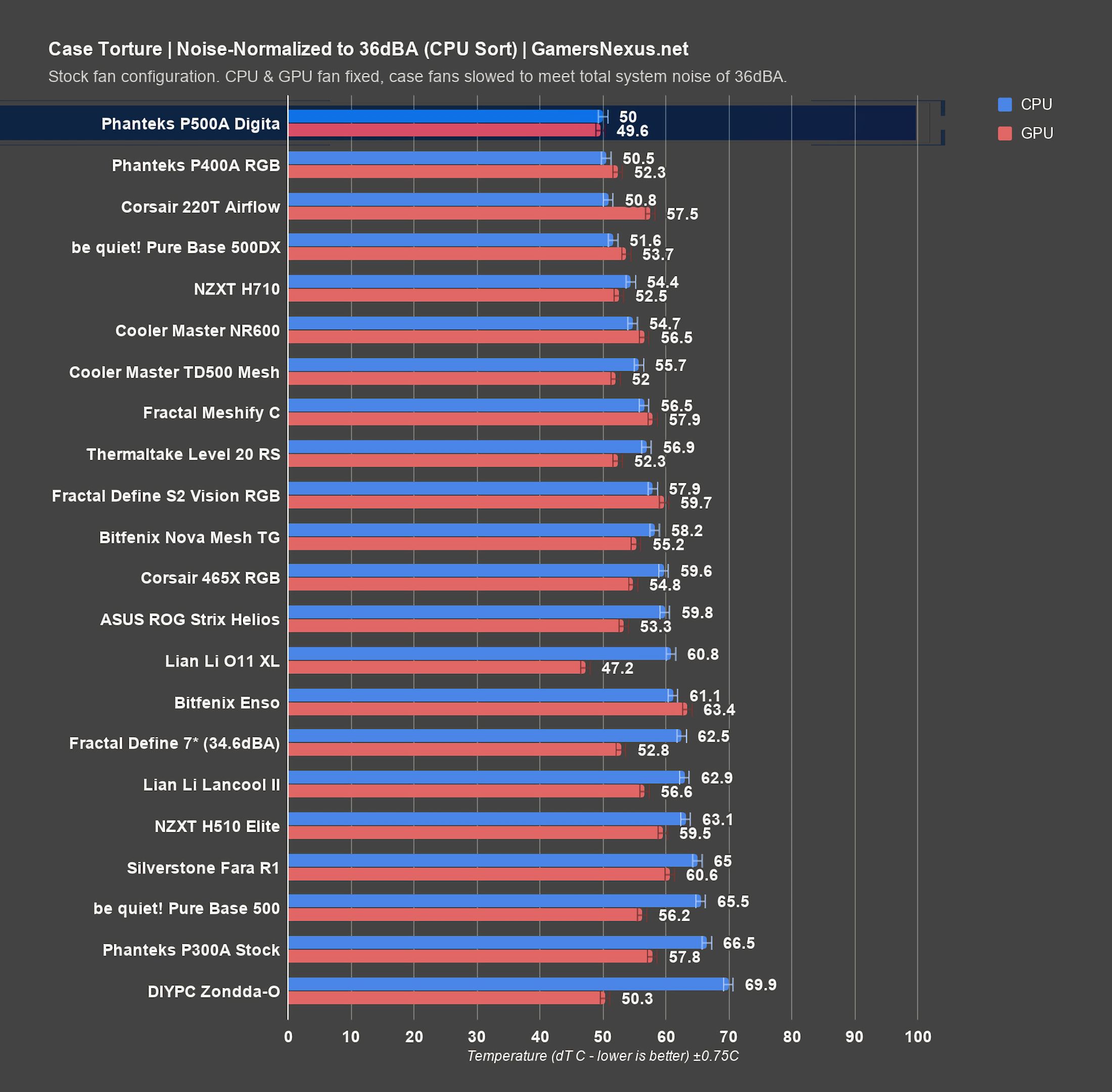
On the same chart, the GPU delta was besides l degrees, a couple degrees warmer than the torture test baseline but all the same impressively close. Once again, this is one of the best GPU temperatures on the chart, and out of the cases configured with only stock fans it'south the best--tied with the $35 Zondda-O, which has a fan pointed straight at the GPU. Anytime manufacturers volition retrieve that they can put fans on the sides of cases. The P500A beat both the P400A and the TD500 Mesh by ii degrees and some alter in this exam. This amount of cooling at this dissonance level is incredible, and nearly all the cases that do well in this test are loftier airflow. Open cases tin can afford to run their fans at much lower speeds, and they therefore often end up quieter than sealed-off cases.
Blender

CPU temperature for the Blender CPU-exclusive render was 36 degrees over ambient, tied with the high-functioning be quiet! 500DX and Cooler Master H500 Mesh. The TD500 Mesh and P400A were slightly warmer, even though the P400A was ahead in the original torture test; this may point the CPU'due south temperature being more afflicted by GPU rut in the P500A's torture testing, which isn't an upshot with this lighter workload.

Using the GPU to render raised GPU temperature to 21 degrees Celsius over ambient, the lowest result on the chart and then far, ahead even of cases with direct GPU cooling like the SL600M. The P400A was two degrees warmer in this test; the CPU temperature here was too cooler than the P400A'southward, although the TD500 Mesh has them both beaten in that category.
Firestrike

The 3DMark Firestrike Extreme stress test resulted in an average GPU temperature within fault of the baseline upshot of 47 degrees. That result is merely as impressive in this test, again most equalling the performance of the SL600M, which has two 200mm fans at the bottom pointed direct into the GPU libation. The TD500 Mesh and P400A tied hither at 49C. The P500A is great at both CPU and GPU cooling, only GPU cooling is where it pulls ahead of Phanteks' own older instance.
Standardized Fans

Our next testing is with standardized fans in all cases, which has a number of of import caveats and shortcomings methodologically that we've pointed out in the past. This was highly viewer requested, so we added it, simply please educate yourself on the limitations of this test by clicking the link to our research piece beneath.
These standardized fan results are more useful if they're treated equally results for the P500A non-Digital--nobody should be ownership the Digital variant with the intention of swapping out the ARGB fans when they could just buy the P500A non-D for $30 less. CPU temperature with the standardized fans was 44 degrees over ambience, even better than baseline. This hasn't always been true in our tests of like cases, simply the P500A is large enough that an exhaust fan tin can be benign by focusing cooling where it'southward needed. 44 degrees ties it with the P400A for the best result on the nautical chart so far, which makes sense--identical fans, similar front panel pattern.

GPU temperature averaged 47 degrees in this test, rounding to 1 caste lower than baseline but in reality near exactly the same. That ties it with the Cooler Chief TD500 Mesh and is beaten only by the cases with directly GPU cooling. Nosotros placed the two 140mm intake fans as low as possible without going below the level of the PSU shroud to effectively residual CPU and GPU cooling, and the event is overall slightly ameliorate than baseline, but not plenty to really thing. The results bear witness that the cooling potential of the P500A matches some of the best we've tested, and and so on top of that the stock fans are good enough to have advantage of that potential.
Decision
The build quality on the Phanteks P500A example is skillful, and it's bigger than the P400A, which is a simple advantage. A bigger case ways more room to work and more room to install parts; the downside is in finding a identify to put it. Phanteks has sprinkled in some features that nosotros previously saw in the Evolv 10 to make this a premium case, some of which nosotros like and some of which we don't, but they're toppings on a solid base. Thermal performance is just as good or better than the P400A Digital's, which was already at the elevation of most of our charts.
This is a expert case with a reasonable MSRP of $130, and for in one case the version with fewer fans may be a adept deal equally well. We recommended the P400A Digital over the base-model P400A because information technology had more than stock fans. As a rule of thumb, case manufacturers can get a meliorate bargain on fans than consumers can, so including a decent set is a huge value add for cases at or beneath the $100 range. Our testing with the P500A revealed that even with two 140mm fans, operation is still skillful, and MSRP for the P500A non-digital is just $100. For those that can live without RGB, that'southward a adept bargain.
If yous're interested in learning more than about alternatives to this case, we've also reviewed (and can recommend considering) these competitors: the Libation Master TD500 (review), Cooler Master H500 'blank' (review), Phanteks' ain P400A (linked in a higher place), the Lian Li O11 Dynamic (review), and plenty of others, simply these are the main ones nosotros'd look at side by side.
Editorial, Testing: Patrick Lathan
Host, Test Lead: Steve Burke
Video: Keegan Gallick, Andrew Coleman

Source: https://www.gamersnexus.net/hwreviews/3601-phanteks-p500a-case-review-thermals-noise-quality
Posted by: kimbroughhimend.blogspot.com
0 Response to "How Much To Install Kitchen Exhaust Fan"
Post a Comment